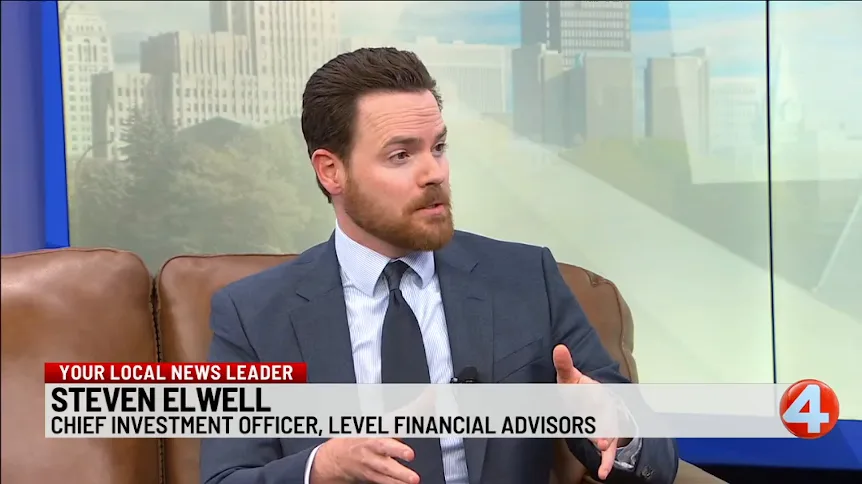
After a stretch of sharp swings in the stock market, many investors are asking what, if anything, they should do. News 4 Buffalo (WIVB) turned to our Partner and Chief Investment Officer, Steven Elwell, CFP®, to help viewers put it in perspective. Anchor Bethany Wagner asked him about volatility, buying opportunities, and the uncertainty surrounding artificial intelligence (AI) stocks.
You can watch the full segment here: Interview: What investors need to know about NVIDIA turmoil impact on Wall Street.
Volatility is part of investing
Steve explained that significant volatility is an occasional cost of investing in stocks. Stocks have historically offered higher long-term return potential than cash or certificates of deposit, and periods of sharp swings come with that. He pointed to March 2020, 1987, and the late 1990s as earlier periods of major market disruption.
Asked whether the market had gone through a full correction, Steve noted that the Nasdaq had declined roughly 19% from its high before rallying about 6.5% that day. That recovered a substantial portion of the decline, but not all of it.
Are downturns an opportunity?
Steve said that, historically, downturns have been attractive times to buy for investors whose time horizon is long enough. Companies keep trying to grow sales and earnings, control expenses, and develop new products. Over time, he described the stock market as having a generally slow upward tendency as the economy expands, new companies are created, and unsuccessful ones are replaced.
The key phrase is “long enough.” Money you will need soon is a different question from money you won’t touch for many years, and that difference is where a financial plan does its work.
What about AI stocks?
Asked whether AI uncertainty could lead to more declines, Steve said uncertainty is always present in markets. Current AI spending involves some of the largest corporate capital expenditures in decades. There is real enthusiasm about what AI can do, and some corporate earnings have supported it. The longer-term question is whether actual results will match elevated expectations. The market will adjust as new information shows whether the promised benefits are showing up.
He also noted that roughly 10 companies have produced extraordinary returns over the past several years, and that performance cannot reasonably continue at the same pace indefinitely. As the old Wall Street saying goes, trees don’t grow to the sky. Steve suggested the next phase of returns could shift from the companies building AI to the companies that use it most effectively, similar to the 1990s, when the benefits moved from the creators of computers and fiber networks to the businesses that used those technologies to become more efficient.
Is it too late to invest in AI?
Steve didn’t say it was necessarily too late. He did advise against concentrating your investments in one or two companies. His alternative: instead of trying to find the single winning company, an investor can own the market as a whole. In other words, buy the haystack instead of searching for the needle.
Volatility and your plan: practical takeaways
- Match your investments to your timeline. Money you’ll need in the near term and money you won’t touch for decades should not be invested the same way.
- Check your concentration. A few large technology companies now make up a big share of many portfolios. Know how much of your money rides on a small number of names.
- Let your plan lead, not the headline. Decisions made in a volatile moment can be hard to undo. A plan built around your goals is the best guide when the news is loud.